
Vance County Arrest Records and Charges
Vance County arrest records are created by law enforcement when a person is arrested, processed, or booked. They can involve the Vance County Sheriff's Office, Henderson Police, or another law enforcement agency. Court charge records begin when the case reaches the court system through a warrant, magistrate order, citation, criminal summons, indictment, information, or similar charging paper. Once the charge is filed or returned, the Clerk of Superior Court maintains the court case record.
The two record paths answer different questions. Arrest records and booking details help explain custody, agency action, and jail processing. Court charges after arrest show what the State alleges in court, which count is pending, which count was changed, and how each charge later ends. For current jail custody and booking limitations, use the Vance County inmate records page. For the full case file, including plea, disposition, sentence, and appeal entries, use the Vance County criminal court records page.
Charges Filed After Vance County Arrests
Charges are prosecuted by the State through the District Attorney after law enforcement arrests, cites, or seeks process against a person. The Prosecutorial District 11 District Attorney covers Franklin, Granville, Person, Vance, and Warren counties. The Vance contact directory lists a local District Attorney contact at (252) 430-5110, and the district office is led by District Attorney Mike Waters. The DA prosecutes criminal cases, prepares criminal trial dockets, and advises law enforcement.
Law enforcement can create arrest, incident, investigation, or booking records. The court maintains the charge and case file. That split matters because North Carolina public records law treats court process differently from active investigation records. A returned warrant, indictment, or criminal summons can become a public court record unless sealed, while an active law enforcement investigation file may not be public.
The Vance County Sheriff's Office services page identifies local sheriff service contacts for reports, investigations, and tips.

The sheriff services page supports the arrest-record side of the Vance County arrest-to-charges path, while filed charges are tracked through court.
Find Vance County Arrest Records and Charges
There is no official Vance County mugshot or arrest blotter database documented in the research. There is also no official Vance County online jail roster. For court charges after arrest, the main online route is the NC eCourts Portal Smart Search. Search by defendant name, case number, citation number, record number, FBI number, SO number, booking number, case type, case status, or file date when those fields are available. Use Vance County as the location filter when possible.
- Use the NC eCourts Portal Smart Search for filed court charges and public case activity.
- Search by defendant name, case number, citation number, record number, or known booking-related identifier.
- Filter to Vance County when statewide results are too broad.
- Open the case and review each charge, count, statute, class, hearing date, status, and disposition.
- Contact the Vance Clerk of Superior Court at (252) 430-5100 for certified records or unclear charge status.
For custody questions, call the Vance County Detention Center at (252) 438-3923 or the Sheriff's Office at (252) 738-2200. For city law enforcement questions, the Henderson Police Department has a non-emergency dispatch line at (252) 492-0202, a front desk/information line at (252) 438-4141, Crime Stoppers at (252) 492-1925, and a Public Information Officer line at (252) 431-6056.
The Henderson Police Department official page is relevant when the arrest or incident involves city police activity.
City police records and court charge records are connected by the same event, but they are held by different custodians.
The Henderson Police contact page lists dispatch, front desk, Crime Stoppers, and public information phone lines.
Those police contacts are useful for arrest or incident questions, while charge status and court dates remain court-record questions.
Vance County Charging Documents
Charges after arrest can enter the court record through more than one document type. The research identifies warrants, magistrate orders, citations, criminal summonses, indictments, informations, and law enforcement charging documents as possible starts for a court charge record. The formal document affects how the case moves, but the key public-record point is that the charge becomes a court record when returned, filed, or otherwise placed in the court case.
| Complaint / Citation / Summons | Information | Indictment | |
|---|---|---|---|
| Filed By | Officer, magistrate process, or prosecutor depending the case. | Prosecutor. | Grand jury process. |
| Common Use | Misdemeanors, infractions, and initial criminal process. | Formal prosecution where allowed by procedure. | Felony prosecution and serious matters. |
| Record Effect | Creates or supports the filed charge and first court settings. | States the prosecutor's formal charge. | Moves the charge into Superior Court prosecution. |
| Where It Appears | Portal docket, clerk file, returned process, or hearing record. | Criminal case file. | Superior Court criminal case file. |
Vance County Charge Status
Charge status can change as a case moves. One arrest can produce several counts, and each count may take a different route. A pending count may later be amended, reduced, dismissed, superseded by indictment, resolved by plea, tried, or sentenced. Do not treat the first charge list as the final outcome. Read the docket entries, disposition, and sentence fields together.
| Status | What It Means |
|---|---|
| Pending | The charge remains open or unresolved in the court record. |
| Amended / Reduced | The charge was changed, narrowed, or replaced by a different offense or count. |
| Dismissed | The charge ended without a conviction on that count, subject to the exact order and context. |
| Nolle Prosequi | The prosecutor elected not to proceed on the charge, if reflected in the court record. |
| Disposed | The charge has a recorded outcome, which may include conviction, dismissal, or other final event. |
| Sentenced | The record may show jail, probation, costs, fines, restitution, or conditions after conviction. |
Vance Charges vs Convictions
A Vance County charge is not the same as a conviction. The charge is the accusation filed after an arrest, citation, warrant, summons, indictment, or related process. A conviction is a court result after a guilty plea, verdict, or judgment. A court charge record can show allegations that were dropped, dismissed, reduced, amended, or resolved without a conviction. This is why each count must be read separately.
| Charge | Conviction | |
|---|---|---|
| Role | Accusation or formal allegation. | Final guilt result by plea, verdict, or judgment. |
| Timing | Appears early and may change during the case. | Appears after adjudication or plea result. |
| Public Record | Often public in the court file unless sealed or restricted. | Often public unless sealed, expunged, juvenile, or otherwise restricted. |
| Practical Reading | Check amendments, dismissals, and count-by-count status. | Check disposition, sentence, costs, and appeal entries. |
Access Rules for Vance Arrest Records
North Carolina law draws a key line between public court process and nonpublic criminal investigation records. G.S. 132-1.4 says criminal investigation and intelligence records held by law enforcement are not public records. The same statute treats returned arrest warrants, search warrants, indictments, criminal summonses, and nontestimonial identification orders as public records unless sealed. That distinction controls many Vance County arrest records and court charge questions.
The criminal investigation records statute explains why an active sheriff or police investigation file may be closed while returned court process is public.
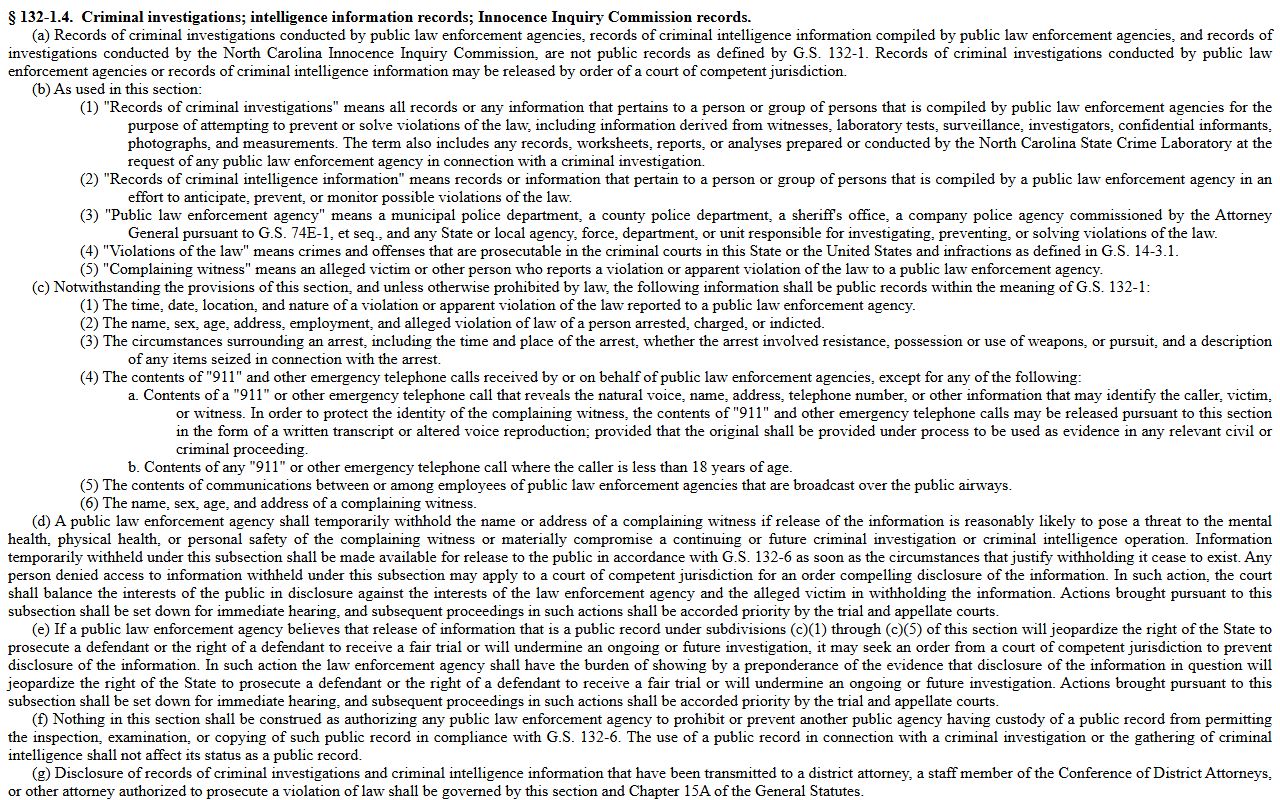
The statute is central to Vance County arrest records because it separates law enforcement investigation files from public court process.
G.S. 132-1 broadly defines North Carolina public records.
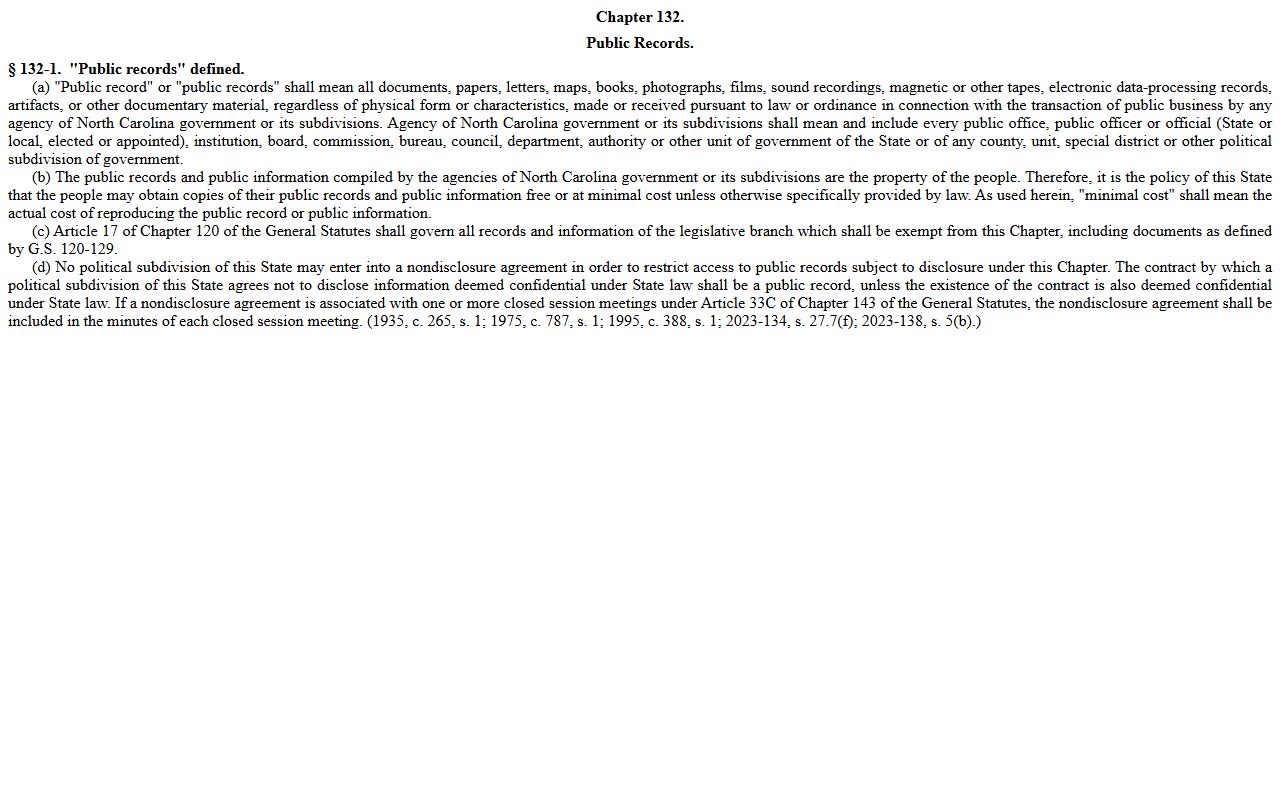
The broad definition supports access to public records, but the arrest-to-charges path still depends on specific criminal and court-record exceptions.
Vance Arrest and Charge Requests
For court charge records, contact the Clerk of Superior Court at 156 Church Street, Suite 101, Henderson, NC 27536, phone (252) 430-5100. For sheriff-created arrest or report records, contact the Vance County Sheriff's Office at 156 Church Street, Henderson, NC 27536, phone (252) 738-2200. For Henderson Police records or incident questions, use the Henderson Police contacts described above. The right custodian depends on whether the record is a court file, sheriff record, police record, or jail custody question.
North Carolina public-record copying rules also matter. G.S. 132-6 addresses inspection and copying. G.S. 132-6.2 limits ordinary copy charges to actual cost unless another law applies and allows special service charges for extensive requests. Clerk fees, such as certified criminal searches and copy preparation, may come from court-specific fee statutes.
The inspection and copying statute is relevant when a Vance County arrest record or court charge request goes to a public-record custodian.
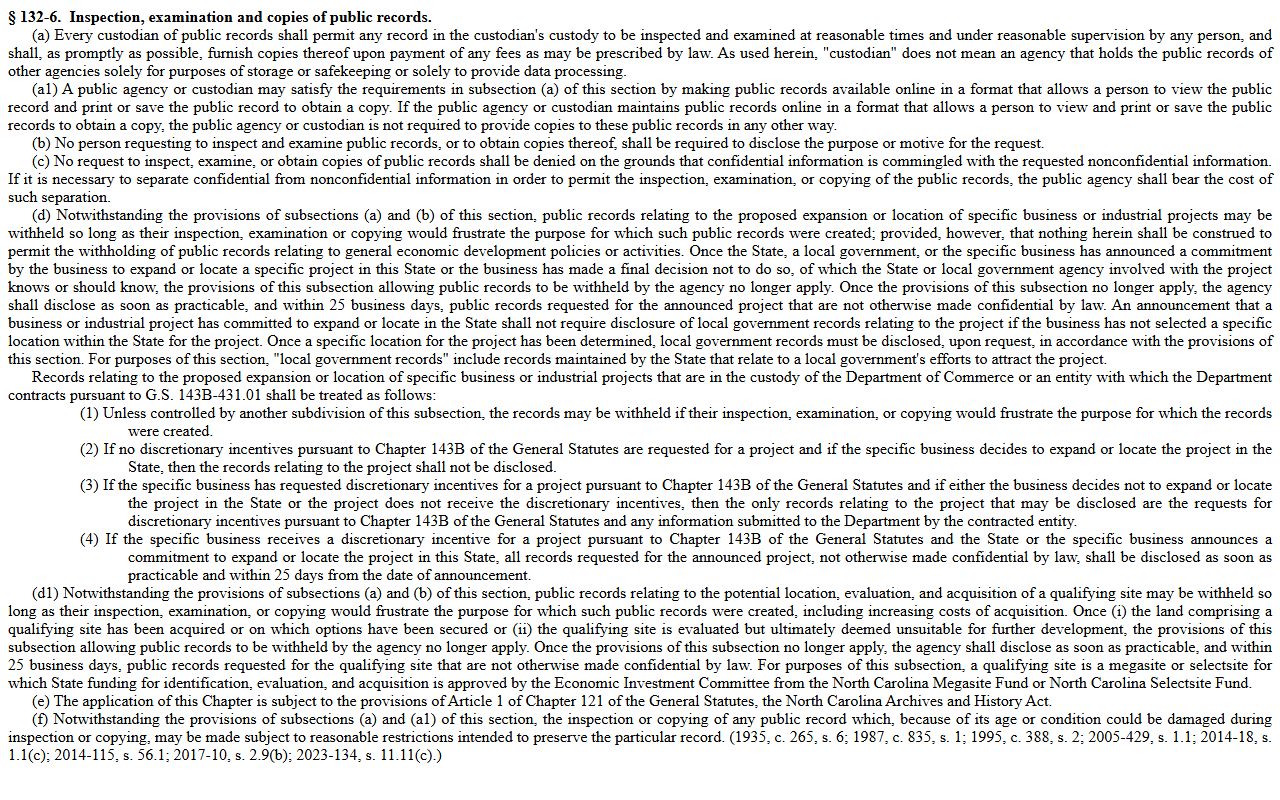
The copying statute supports lawful requests but does not override sealed court orders, juvenile confidentiality, or criminal investigation limits.
Statewide Charge and History Lookups
Statewide court case information is searched through the same NC eCourts Portal used for Vance County records. Bulk or recurring statewide court data may require the NCAOC Remote Public Access Program, which is licensed and fee-based. Certified county criminal record searches are done through the Clerk of Superior Court in the county where the search is needed. For Vance County, that means the local clerk and the $25 certified county criminal search fee identified in the research.
State prison, probation, and parole records are separate. The NC Department of Adult Correction offender search can help with state offenders, probationers, and parolees, but it is not a Vance County jail roster and does not show every pretrial detainee. No official Vance County Sheriff's Office app or Henderson Police app was found, and the build should not point users to apps for a different Henderson County.
Restricted Vance Charge Records
Juvenile charges and juvenile petitions are not ordinary public records. G.S. 7B-3000 restricts juvenile delinquency and undisciplined records, and G.S. 7B-2901 restricts abuse, neglect, and dependency records. Expunction is also a major limit. G.S. 15A-145.5 provides eligibility rules for certain nonviolent misdemeanor and felony expunctions, and G.S. 15A-151 makes expunction records confidential after an order is entered.
Sealed warrants, active investigation files, protected addresses, mental health material, adoption records, Social Security numbers, financial account numbers, and minor identities may be withheld or redacted. A missing online charge detail does not prove no record exists. It may mean the detail is sealed, confidential, available only through the clerk, held by another custodian, or not part of the court record.
Note: For safety or active-warrant concerns, contact official offices or counsel rather than relying on unofficial lookup pages.